Saturday, July 2, 2011

Nokia N9 smartphone


the meego-powered 'nokia n9' smartphone


just introduced at the nokia connection 2011 in singapore, the new 'nokia n9' smartphone features a pure-glass display controlled only by touch, designed with three home interfaces to deliver easy access to common functions.
the device's 3.9-inch AMOLED screen is made from curved scratch-resistant glass, with a polycarbonate body designed to optimize antenna performance and improve reception.

in place of a home key, the meego-powered 'n9' recognizes a swipe gesture to return from applications to one of the three home interfaces.
these three individual views-- 'event', 'apps', and 'open apps'-- are designed to offer immediate access to social media and event notifications and using or switching across applications.


left to right: the 'event', 'apps', and 'open apps' home screens


near field communications (NFC) permits the sharing of images and videos between devices by simply touching them together; it also facilitates the use of bluetooth accessories like speakers; in particular, the phone is compatible with the newly released NFC-enabled 'nokia play 360°' speaker, usable with the 'n9' through a simple tap.

a 8MP zeiss sensor and built-in flash enable photography and HD video capture, while videos can be watched on the device in 16:9 widescreen. the 'n9' is also the first smartphone to feature dolby digital plus decoding and headphone post-processing technology for a surround sound experience when using headphones.

free maps and navigation covering 90 countries is integrated with the 'drive' app for in-car navigation. the phone also features built-in apps that include mail software and the 'documents' application, permitting the viewing of word, excel, powerpoint, and pdf files; additional apps are available on the nokia ovi store, where the company also encourages and facilitates custom app development.


full view, landscape mode


the nokia 'n9' is expected in stores later this year, produced in black, cyan, and magenta and featuring either 16GB or 64GB of memory.


3/4 front and full side views


in place of a dedicated key, swiping towards the edge of the screen opens the home page from any application


the 'n9' features near field communications technology, so that data can be transferred between phones with a simple tap


preview video of the n9


nokia's senior vice president of design marko ahtisaari discusses the design of the new smartphone 

via designboom 

source DesignFields

sobi: social bicycle bikeshare


the 'sobi' ('social bicycles') system makes use of existing infrastructure and GPS-enabled bikes for a dynamically managed bikeshare


centered around city bikes featuring GPS-enabled electronic lockboxes, the 'social bicycles' ('sobi') concept utilizes the existing infrastructure of urban and tourist destinations, in conjunction with mobile networking, to create a dynamically managed bikeshare system. expecting the delivery of the first 60 prototype bicycles this october, founder ryan rzepecki plans to have a complete system ready for implementation in 2012.
the 'sobi' team is currently seeking kickstarter funding, where interested readers can also learn more about the concept.

'we have smart bikes, not smart racks,' rzepecki explains: 'our lock works with regular bike racks and does not rely on expensive kiosks and docking stations.'

the innovative model has a cost-per-bike of less than one third of that of a standard station-based system.
'sobi' bikes are primarily based in central areas designated as system hubs, but users are permitted to lock and leave their bicycles anywhere within the system zone. incentive-based demand management puts the task of inventory control onto users: users who leave bikes anywhere outside a hub are charged a fee, and a user who returns that bike to a system hub earns the equivalent amount in credit. the GPS in the devices, as well as their identifiable frame,
reduces the risk of theft.

each bicycle in the fleet is monitored via a lockbox that has been installed onto its seat tubes. the box is built with an on-board computer and GPS-enabled lock, and data is communicated to and from the 'sobi' server.
the box doubles as a carry basket, and features retro-reflective paint and automatically engaged LED rear lights.
the 'sobi' team has also designed its own custom bike frame, featuring an adjustable, non-removable seat and front carry basket. the lights and onboard electronics are kept charged via a photovoltaic panel installed on the back lockbox panel.


video demo of the 'social bicycles' system


brooklyn-based industrial designer nick foley elaborates on the bicycle's design:

'the direction we chose for our bicycle was something of a classic design, guided by a modern utilitarianism.
the classic 'step-through' geometry is a time-tested way of making a bicycle easy to mount and dismount for people of any level of flexibility. the shaft drive, which may seem like a novelty or innovation, is actually a well-established technology [...] perfectly suited for bike-sharing applications, where the small amount of added weight is negligible considering to the higher durability and cleanliness compared to a chain and chainguard.
'


full view rendering of the bike


full view of the lockbox and keypad


users register for the 'sobi' system online via computer or smartphone application, or at dedicated street kiosks or subway ticket vending machines. once his account has been created, a user can access a bicycle by entering his PIN number into the keypad on the bike's lockbox, or by sending a request via text message, phone call, or through the smartphone app.
the application also offers an interface for searching for nearby bikes, marking those that are available as well as those that need to be returned to a hub, earning him credit.

the user is charged based on the amount of time he uses the bike. locking automatically ends the transaction and labels the bike as available to other users; although users may also 'hold' their bike for up to ten minutes, during which it should be locked down but is not registered on the system as being available. although the bicycles are designed to be durable, resistant to reckless behaviour or vandalism, users can also mark a malfunctioning bike
as in need of repair, and 'sobi' operators will locate the bike and address the problem.


example screenshot from the 'sobi' smartphone application


example views of the system information available to users via the smartphone app


the 'sobi' system is designed for easy integration into urban or resort environments, making use of existing bike racks.
the current bicycle design sees the lockbox built directly into the bike frame, a more cost-efficient and secure option to an earlier design model, which considered the possibility of mounting the lockbox onto the seat tube of existing bikes.

the system, with its GPS data, facilitates self-management: information from bike density 'heat maps' and frequent user travel paths enables 'sobi' staff to redistribute bicycles or reposition entire system hubs to best serve user needs. the lack of required infrastructure other than the bikes themselves means that system hubs and services can even be altered to reflect seasonal or other changes in user habits.

users can connect through a 'sobi' social network, view maps and data about their travel habits, and see approximately how many calories they have burned and how much carbon emission they have prevented using the bikes. they can also search for bikes, setting the boundaries of the system and hub zones in which they would like to find one.


rendering of a system hub, which makes use of existing bike racks


view of the bicycle locked


structural diagram of interior of lockbox


most recent prototype of the lockbox casing


diagram of the locking mechanism for an early lockbox design (top row: locked; bottom row: unlocked);
the current U-lock model functions similarly but is more secure, can be used from both sides of the bicycle and lock to larger objects


the new york -based 'sobi' team is composed of founder ryan rzepecki; industrial designers ted ullrich and nick foley; web and app designers we less than three (andy gillette and ashley quinn); software engineers mike hill, mike castleman, anish patel, victor sima, and tim johnson; and engineers jon pettingill, andrew baker, matt hagan, and matt stevenson.


'social bicycles' founder ryan rzepecki explains the concept in his kickstarter promo video


via designboom 


source DesignFields

pavel novák: 8-bit invader projection mapping


'8-bit invaders' projection mapping by pavel novák 

'8-bit invader' is a work of projection mapping created by czech designer pavel novák for the 5th anniversary of tomas bata university's department of visual arts in zlín, czech republic.

the display playfully conflates the real and virtual worlds, first using the edifice simply as a surface onto which novák's own fictional game 'furniture catchers' is loaded via the command line. for a few seconds, pixelated people appear in the sites of the building's real windows to drop furniture, which a digital truck on street level moves to try to catch. after an alleged system error converts the building temporarily into the 'blue screen of death', a series of iconic games are displayed in play, with architecture elements of the building incorporated into the gaming landscape.


full simulation of '8-bit invaders' 


the simulation begins with a fake command line input screen 


additional view 


video of several projects, including '8-bit invader', projection mapped at the event 

via computerlove

via designboom 


source DesignFields

Pop Art Prêt-à-Porter


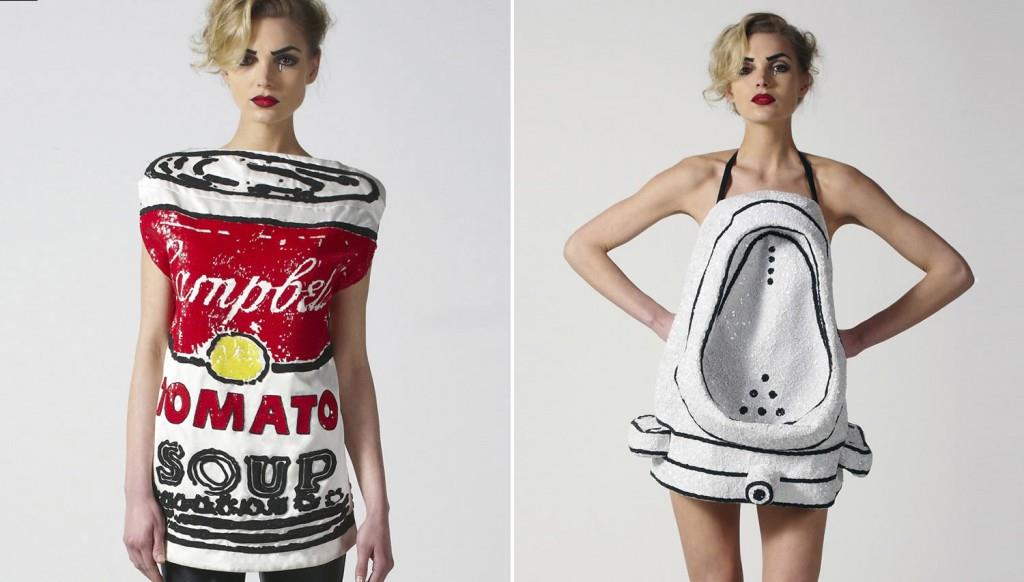
Venus in Sequins by Philip Colbert
Dresses inspired by Andy Warhol and Marcel Duchamp
Designer Philip Colbert has launched Venus in Sequins, a daring fashion collection perfect for that pop art princess in your life. While it's probably not wise to go out wearing the Urinal Dress (unless you're looking to be a walking sandwich board advertising golden showers), conceptually, I think these are amazing.
Venus in Sequins by Philip Colbert
Dresses inspired by Dali and Van Gogh
Created and designed by Philip Colbert, the label is inspired by developments in the modern art world, in particular the work of Marcel Duchamp and the Pop Art movement. 'The Rodnik Band' label is presented as a pop band rather than a traditional fashion label. The collection is a unique amalgamation of music, art and fashion which combines three closely associated genres to create a unique fashion concept.
Andre Leon Talley referred to Venus in Sequins as: "The best thing since Warhol". This is high praise from a man who currently spends his time on America's Next Top Model telling young ladies whether they're "fierce" or "dreckitude".
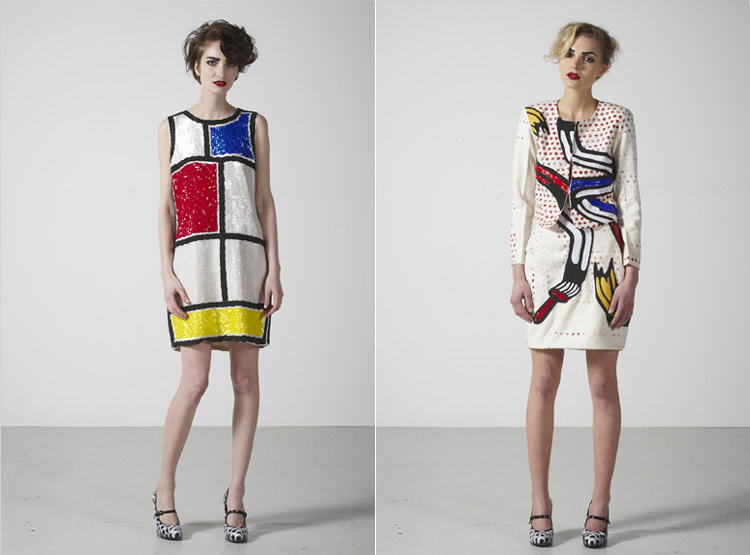
Venus in Sequins by Philip Colbert
Dresses inspired by Mondrian and Lichtenstein
The Venus in Sequins collection was exhibited at London Fashion week. Each dress is hand-crafted with over three weeks of sequin and embroidery work. Wearable art frames are supplied with each dress. Prices are as follows: Warhol (£1,195), Mondrian (£895), Lichtenstein (£925), Dali (£1,600) and Van Gogh (£1,295). They are currently available in limited editions from Not Just a Label.
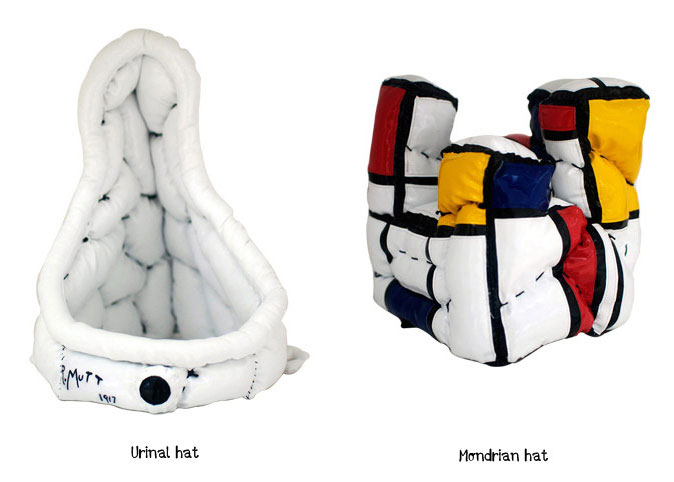
Venus in Sequins by Philip Colbert
Hats inspired by Duchamp and Mondrian
I couldn't find any pricing on the hats, which is a bummer because plush that invites folks to piss in it seems like a really smart idea. All jokes aside, I really love this line. When Colbert does Keith Haring menswear, I'll be lining up. Kudos to any and all women who are bold enough to wear Venus in Sequins. Click through for a video.
VIA JEREMYRIAD 
source designfields 

Friday, July 1, 2011

LIFE-SIZE LUNO THE MOON ROVER?

pussycar-automodule1.jpg

What's this? A real life Luno the Moon Rover? Nope. According to the excellent How to Be a Retronaut blog, it's a futuristic vehicle awesomely titled "The Pussycar Automodule." Designed by Jean Pierre Ponthieu in the 1970s, the Pussycar Automodule was created as a promotional vehicle and described as "The Car of the Year 2000″. Better luck for 2020. 

via jeremyriad 

source kitsch thing of the day 


pavel novák: 8-bit invader projection mapping


'8-bit invaders' projection mapping by pavel novák 

'8-bit invader' is a work of projection mapping created by czech designer pavel novák for the 5th anniversary of tomas bata university'sdepartment of visual arts in zlín, czech republic.

the display playfully conflates the real and virtual worlds, first using the edifice simply as a surface onto which novák's own fictional game 'furniture catchers' is loaded via the command line. for a few seconds, pixelated people appear in the sites of the building's real windows to drop furniture, which a digital truck on street level moves to try to catch. after an alleged system error converts the building temporarily into the 'blue screen of death', a series of iconic games are displayed in play, with architecture elements of the building incorporated into the gaming landscape.


full simulation of '8-bit invaders' 


the simulation begins with a fake command line input screen 


additional view 


video of several projects, including '8-bit invader', projection mapped at the event 

via computerlove


---


designboom reminder: infiniti digital art competition


designboom in collaboration with INFINITI is offering an international competition asking participants to design spectacular or interactive digital artworks, to be installed throughout europe and voted on to win the 10,000 euro first prize.

submissions may take the form of projection mapping, interactive sculptures, video or flash files, processing or max applications, or other digitally mediated works, but register now!
the first round of the competition, featuring the theme 'inspired performance', ends friday, july 8th


via designboom 

source DesignFields

helen pynor: liquid ground

'breath' by helen pynor
GV art gallery, london, UK
on now until july 2nd, 2011


'liquid ground' by helen pynor
all images courtesy helen pynor and GV art gallery
(above) 'liquid ground 1'
c-type photographic print, face mounted on glass
160 x 110 cm
image © helen pynor


conceived from her research into the numerous recorded cases of accidental drowning in london's thames river, australian artist helen pynor has created 'liquid ground', a series of large-scale photographs which capture various water-buoyed garments expelling human organs from within its floating form. simultaneously haunting and surreal, the unexpected injection of internal organs into an otherwise dreamy underwater scene results in a collection of images that is arresting in both a visual and visceral manner. 

pynor explores new ways in which we can relate to our body's makeup by rejecting the celebration of gore and horror but drawing from both personal and cultural stories. utilizing phantom forms, the notion of the human body is approached in a highly sensitive and emotional manner despite the morbidity of the subject matter. 


detail
image © helen pynor


'liquid ground 2'
c-type photographic print, face mounted on glass
160 x 110 cm
image © helen pynor


detail
image © helen pynor


'liquid ground 3'
c-type photographic print, face mounted on glass
160 x 110 cm
image © helen pynor


'liquid ground 6'
c-type photographic print, face mounted on glass
160 x 110 cm
image © helen pynor


detail
image © helen pynor


'liquid ground 4'
c-type photographic print, face mounted on glass
160 x 110 cm
image © helen pynor

via designboom

source DesignFields